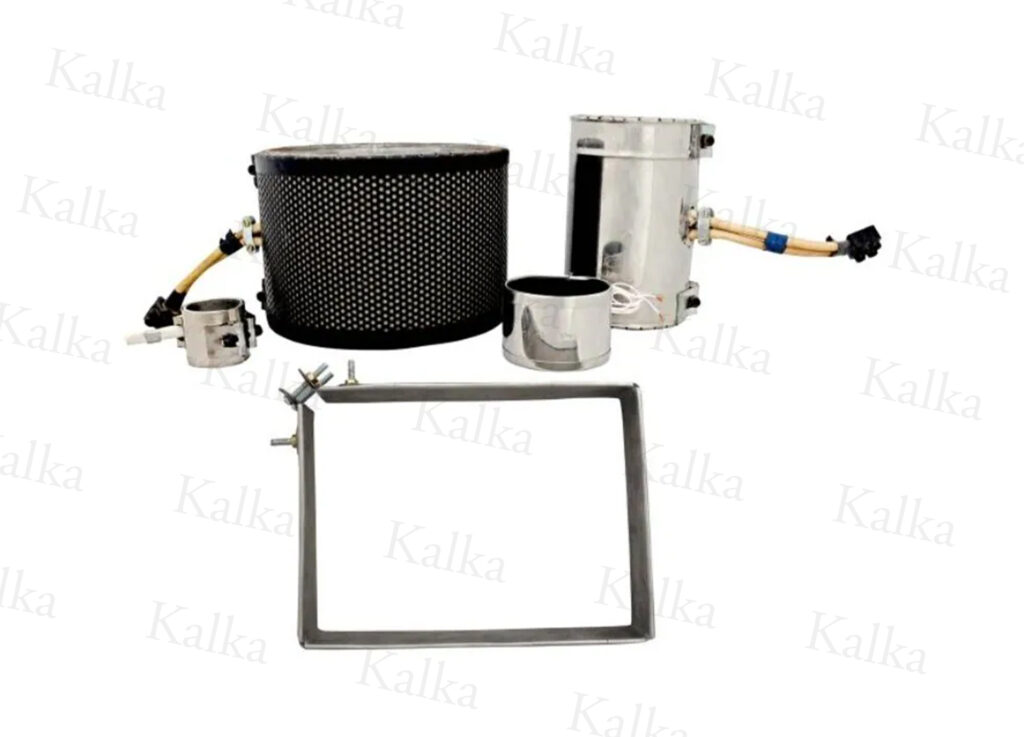
Choosing the right industrial heater is not simply about selecting the lowest-priced option. The heater you install can affect heating speed, temperature stability, energy consumption, production quality, maintenance requirements, and machine downtime. This is particularly important for injection molding, plastic extrusion, blow molding, packaging, and other industrial processes where consistent heat is essential.
Two commonly used options are Mica Band Heater and ceramic band heaters. Both are designed to heat cylindrical surfaces such as barrels, pipes, nozzles, and processing equipment, but their construction and performance characteristics are different.
So, which one should you choose?
The answer depends on your operating temperature, machine design, heating requirements, production cycle, available space, energy-efficiency goals, and budget.
In this guide, we compare Mica Band Heater and ceramic band heater technology to help industrial buyers make a practical purchasing decision.
What Is a Mica Band Heater?
A Mica Band Heater is an electrical heating element designed to wrap around cylindrical equipment and transfer heat through the heater’s metal sheath to the target surface.
Mica is used as an electrical insulating material around the resistance element. The assembly is generally protected by a metal sheath, with resistance materials such as nickel-chromium alloys commonly used in the heating element.
Because mica insulation allows a compact construction and efficient heat transfer, these heaters are widely used where fast heating, compact dimensions, and moderate operating temperatures are important.
Typical applications include:
- Injection molding machines
- Plastic extrusion equipment
- Blow molding machines
- Packaging machinery
- Nozzle heating
- Die heating
- Pipes and cylindrical equipment
- Food and processing machinery
- Laboratory and specialized industrial equipment
A major advantage of a Mica Band Heater is that it can be manufactured in different dimensions and configurations according to the equipment. This makes correct sizing especially important when replacing an existing heater.
What Is a Ceramic Band Heater?
A ceramic band heater uses ceramic insulation around the resistance heating element. The ceramic construction provides greater thermal insulation and is generally preferred for applications requiring higher temperatures, longer operating cycles, and improved heat retention.
Ceramic band heaters are commonly used in plastic processing, extrusion, molding, pipe heating, and other industrial applications where higher-temperature performance is required. Depending on the design, ceramic band heaters can operate at considerably higher temperatures than conventional mica designs.
The ceramic structure also helps reduce heat loss from the heated surface to the surrounding environment, which can be valuable for machines operating continuously.
Mica Band Heater vs Ceramic Band Heater: Key Differences
Before choosing a heater, it is useful to compare the two options based on the factors that actually affect industrial performance.
| Feature | Mica Band Heater | Ceramic Band Heater |
| Insulation | Mica | Ceramic |
| Best suited for | Moderate-temperature applications | Higher-temperature applications |
| Heating response | Generally fast | Stable and well insulated |
| Heat retention | Moderate | High |
| Initial cost | Generally lower | Generally higher |
| High-temperature capability | Limited compared with ceramic | Higher |
| Flexibility | Compact and adaptable | More rigid depending on design |
| Energy efficiency | Good for suitable applications | Strong advantage in long/high-temperature operation |
| Common use | Injection molding, extrusion, packaging | High-temperature extrusion, molding, and industrial processes |
The exact operating temperature, watt density, dimensions, sheath material, and construction should always be confirmed with the heater manufacturer because specifications vary between designs.
1. Temperature: Which Heater Can Handle More Heat?
Temperature is one of the most important factors when selecting a band heater.
A Mica Band Heater is generally suitable for moderate-temperature applications. Some manufacturers specify mica designs around 350–450°C or higher depending on construction, while other designs have lower recommended sheath temperatures. Therefore, buyers should not rely on a generic temperature figure alone.
Ceramic band heaters are generally selected when the application demands higher operating temperatures. Some commercial ceramic designs are rated in the 650–760°C range, although the actual permissible temperature depends on construction and operating conditions.
Simple rule:
If your process operates comfortably within the recommended range of a mica heater, mica can be an economical choice. If your process requires substantially higher temperatures, ceramic is usually the more suitable option.
2. Heating Speed and Thermal Response
Heating speed matters when a machine needs to reach its operating temperature quickly.
A Mica Band Heater has a compact construction and can provide rapid heat transfer, making it useful for applications where quick heating and temperature changes are important. Mica heaters are also commonly selected for applications requiring relatively fast heat-up and cool-down cycles.
Ceramic heaters have greater insulation and thermal mass. Instead of focusing only on rapid heat-up, they are often advantageous when the process needs stable and sustained temperatures over longer production cycles.
Therefore:
- Choose mica when quick thermal response is a priority.
- Consider ceramic when heat retention and stable continuous operation are more important.
3. Energy Efficiency
Energy efficiency is becoming increasingly important for manufacturers because industrial heating equipment can consume significant amounts of electricity.
Ceramic insulation can reduce heat escaping from the heater into the surrounding environment. This can make ceramic band heaters particularly attractive for continuous production and higher-temperature applications.
However, it would be misleading to say that ceramic is automatically more energy efficient in every application.
If a machine operates at a moderate temperature and requires rapid heating, a correctly designed Mica Band Heater may provide excellent performance without the additional cost of ceramic construction.
The best approach is to compare:
- Required operating temperature
- Heater wattage
- Watt density
- Heating cycle
- Insulation around the machine
- Production hours
- Temperature-control system
- Heat loss from the equipment
In other words, heater selection should be based on the complete application rather than insulation material alone.
4. Cost: Is Mica or Ceramic More Affordable?
For many buyers, purchase price is an important consideration.
Generally, mica band heaters have a lower initial cost than ceramic band heaters because of their construction and material requirements.
This makes a Mica Band Heater attractive for the following:
- Standard injection molding applications
- Moderate-temperature processes
- Replacement heaters
- Cost-sensitive machinery
- Applications where extreme temperature capability is unnecessary
Ceramic band heaters generally have a higher initial investment. However, their higher-temperature capability, insulation performance, and potential service-life advantages can make them worthwhile for demanding applications.
Instead of asking only, “Which heater is cheaper?”, industrial buyers should ask:
“Which heater provides the lowest total operating cost for my application?”
A cheaper heater that fails repeatedly can become more expensive through replacement costs and production downtime.
5. Service Life and Reliability
Heater life depends on much more than whether the insulation is mica or ceramic.
Important factors include:
- Correct heater dimensions
- Proper installation
- Correct voltage
- Appropriate wattage
- Correct watt density
- Temperature control
- Machine surface condition
- Moisture and contamination
- Mechanical handling
- Operating temperature
Ceramic band heaters are generally preferred for demanding, high-temperature applications because their construction is designed for higher-temperature operation. Mica heaters can provide reliable service when used within their recommended operating conditions.
One of the most common mistakes is selecting a heater solely on price and then operating it outside its recommended specifications.
6. Installation and Fit
A high-quality heater cannot perform properly if it does not fit the machine correctly.
For a cylindrical application, the inside diameter, heater width, heated length, voltage, wattage, and terminal configuration should be checked before ordering.
A poor fit can create air gaps between the heater and the barrel. This can interfere with heat transfer and may contribute to overheating or premature heater failure.
Band heaters can be supplied with different mounting and termination options, including screw terminals, leads, quick-release arrangements, and other configurations depending on the application.
For replacement orders, provide the manufacturer with the existing heater’s specifications whenever possible.
7. Mica Band Heater for Injection Molding
Injection molding is one of the most common applications for band heaters.
The heater is installed around the machine barrel or nozzle to maintain the temperature required for processing plastic materials.
A Mica Band Heater can be a suitable option when:
- The required temperature is within its rated range
- Rapid heating is important
- Space around the barrel is limited
- A compact heater is preferred
- The application requires customized dimensions
- Initial purchase cost is important
For high-temperature materials or demanding continuous production, ceramic may be worth considering.
The correct choice should be based on the actual processing temperature and machine manufacturer’s requirements rather than simply choosing the heater used on another machine.
8. Mica Band Heater for Plastic Extrusion
Plastic extrusion requires continuous and consistent heating along the barrel.
Temperature variation can affect material flow and the consistency of the final product. Band heaters therefore need to provide appropriate heat distribution while working with the machine’s temperature-control system.
A Mica Band Heater can be useful for extrusion applications operating within the heater’s recommended temperature range.
For higher-temperature extrusion or processes requiring greater thermal insulation, ceramic band heaters may provide an advantage.
Which One Should You Buy: Mica or Ceramic?
There is no universal winner.
Choose a Mica Band Heater if:
- Your operating temperature is moderate
- You need fast heat transfer
- You want a compact heating solution
- Your application is cost-sensitive
- You need customized dimensions or cut-outs
- Your machine operates within the heater’s recommended temperature range
Choose a ceramic band heater if:
- Your process requires higher temperatures
- The machine runs for long continuous cycles
- Heat retention is important
- Reducing heat loss is a priority
- You need a heater designed for demanding thermal conditions
- A higher initial investment is acceptable
The correct selection depends on the complete operating environment, not simply the heater’s name.
What Should You Check Before Ordering a Band Heater?
Before placing an order, provide your heater manufacturer with as much information as possible.
Check these specifications:
- Inside diameter
- Heater width
- Voltage
- Wattage
- Operating temperature
- Maximum temperature
- Sheath material
- Terminal or lead arrangement
- Thermocouple opening, if required
- Machine or barrel application
These details help the manufacturer recommend a heater that matches the equipment.
A properly specified heater can improve heating consistency and reduce the risk of avoidable replacement problems.
Common Mistakes When Buying a Band Heater
Choosing Only on Price
The cheapest heater is not necessarily the most economical option. Consider operating life, energy use, replacement frequency, and downtime.
Ignoring the Operating Temperature
Never select a heater without checking the actual process temperature and the heater’s rated limits.
Ordering the Wrong Size
Even a high-quality heater may perform poorly if its diameter or width does not match the heated surface.
Using Incorrect Wattage
Wattage must be selected according to the equipment and process. Incorrect watt density can affect heating performance and heater life.
Not Considering Insulation
Machine insulation can have a major effect on overall heat loss. Improving the heater alone may not solve an energy-efficiency problem if substantial heat is escaping from the equipment.
Why Custom Band Heater Selection Matters
Industrial machines rarely have identical heating requirements.
Two injection molding machines may have different barrel diameters, lengths, temperatures, wattages, thermocouple positions, and terminal arrangements.
That is why buying a standard heater without checking the application can lead to poor fitting or unsatisfactory performance.
A professional industrial heater manufacturer can help determine the appropriate Mica Band Heater or ceramic band heater based on the machine’s dimensions and operating conditions.
Final Verdict: Mica Band Heater vs Ceramic Band Heater
So, Mica Band Heater vs Ceramic Band Heater—which one should you buy?
If your application requires moderate temperatures, fast heat transfer, compact construction, and a lower initial investment, a mica band heater can be an excellent choice.
If your application requires higher temperatures, stronger thermal insulation, sustained operation, and improved heat retention, a ceramic band heater may be more appropriate.
The most important point is that there is no “best” heater for every machine. The best heater is the one correctly matched to your temperature, dimensions, wattage, production cycle, material, and machine requirements.
If you are unsure which type is suitable for your machine, don’t select a heater based only on price or a generic specification. Share your barrel diameter, heater width, voltage, wattage, and operating temperature with an experienced industrial heater manufacturer and get the configuration checked before ordering.
Looking for the Right Mica Band Heater?
Need a Mica Band Heater for injection molding, extrusion, packaging, nozzle heating, or another industrial application? Get your machine specifications checked before ordering and choose a heater designed for your actual operating conditions.
Contact Kalka Heater for assistance with the right industrial heating solution and request a quotation for your application.
Frequently Asked Questions
1. What is a Mica Band Heater used for?
A Mica Band Heater is commonly used for heating cylindrical equipment such as injection molding barrels, extrusion machines, nozzles, pipes, and other industrial processing equipment. It is suitable for applications requiring efficient and controlled heating.
2. What is the difference between a Mica Band Heater and a ceramic band heater?
The main difference is the insulation material and operating capability. Mica heaters are generally preferred for moderate-temperature applications and fast heating response, while ceramic band heaters are typically selected for higher-temperature applications and better heat retention.
3. How do I choose the right Mica Band Heater for my machine?
Consider the inside diameter, heater width, voltage, wattage, operating temperature, terminal configuration, and heating area. Providing these specifications to the manufacturer helps ensure the heater fits correctly and delivers the required performance.
4. Can a Mica Band Heater be customized?
Yes. A Mica Band Heater can be manufactured according to specific machine requirements. Customization may include diameter, width, wattage, voltage, terminal position, thermocouple openings, and other required cut-outs.
5. How can I order a Mica Band Heater for my industrial application?
You can contact Kalka Heater with your machine’s specifications, including diameter, width, voltage, wattage, and operating temperature. The technical team can help identify a suitable configuration and provide a quotation based on your requirements.